
This was the question posed by Greg Foot on BBC Radio 4’s Sliced Bread (episode 16) on 16th April 2026. The featured listener had tried both traditional and infrared saunas. For him, the infrared sauna felt cooler and more bearable. He could sit in one for a whole day. He'd even tried one with a TV in it, but he wondered if it’s healthy to sit in a sauna for that long. He was keen to understand the science and compare the health benefits of each type of sauna.
Joining Greg to answer questions was Chris Minson - Professor of Human Physiology who has researched human adaptations to environmental extremes, biomarkers of cardiovascular health, and autonomic-vascular regulation for over 24 years at the University of Oregon.
It was a fascinating programme. Here we share his views, along with suggestions from our founders on how to apply his insights.

What is the difference between an infrared and traditional sauna?
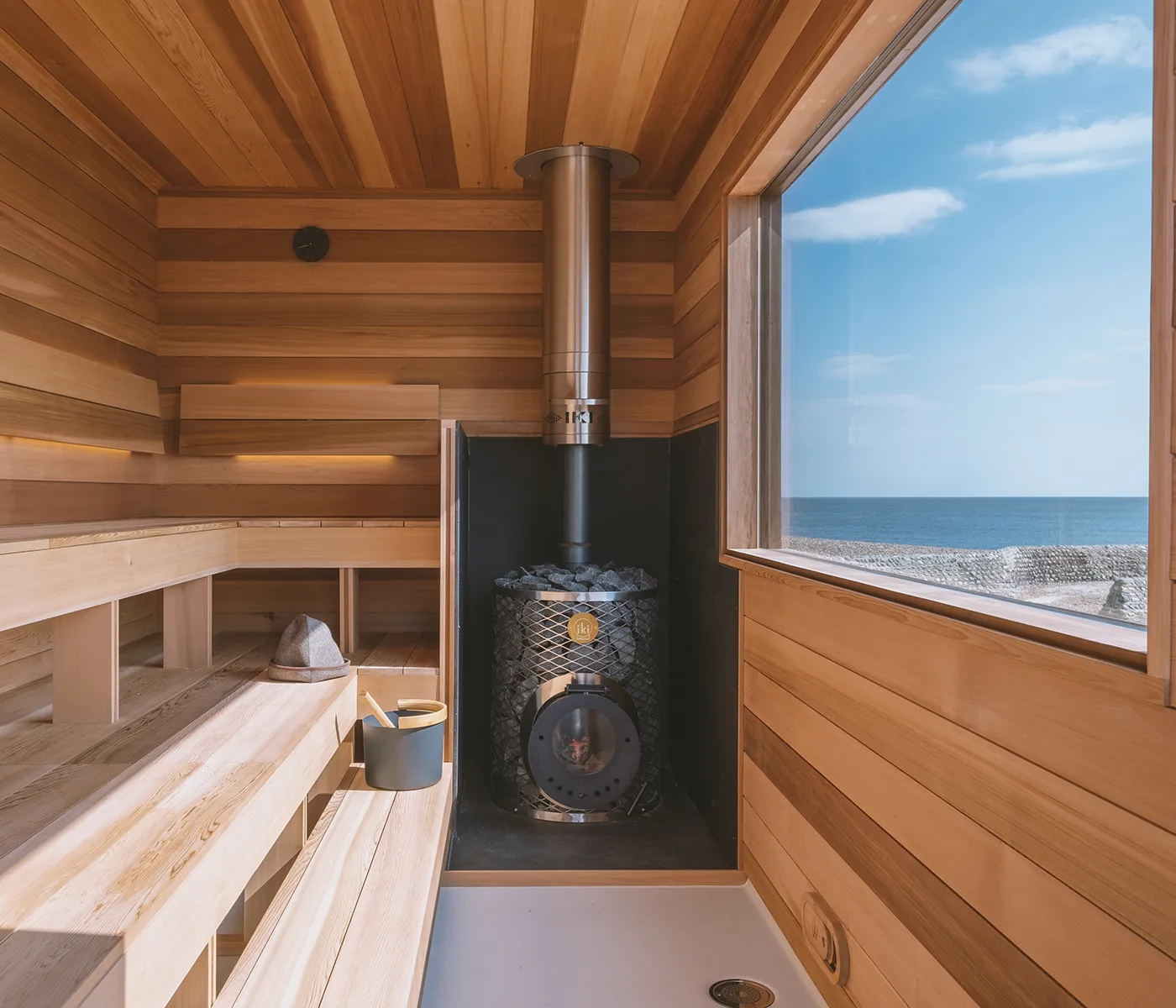
A traditional sauna, sometimes called a Nordic or Finnish sauna, heats the air around you. Temperatures typically sit around 70 - 100°C, and the warm air heats your body from the outside in.
An infrared sauna works differently: the infrared panels emit electromagnetic waves that penetrate the skin directly, warming you from the inside out at a much lower ambient temperature.
The fundamental difference is in heating mechanism, not just how hot the room feels.
The key findings and our take on each
- Saunas put our bodies under heat stress, which has health benefits. As our skin reacts to the heat and body tissues warm, our heart rate and blood flow increases – in a similar way that happens when we exercise. Allowing time to react to and recover from that stress is key to improving your health.
Our take: Sauna research shows that a 30-minute rest, covered in a blanket, following a few short (10-minute) sessions in a traditional sauna, is the optimal way to recover.
- A traditional sauna has a much stronger body of evidence for health benefits – it works at a high temperature (up to 100 degrees) – heating you from the outside in.
Our take: We need no convincing that a traditional Nordic sauna is the best sauna experience you can get. Research points to the best way to extract maximum health benefits as frequency. Nordic sauna bathing once a week can decrease your risk of common health problems while also improving mental wellbeing, sleep, and longevity. These benefits are magnified with frequency, classified in research at 2–3 and 4–7 sessions per week, with optimal health benefits realised at 4-7 sessions a week.
- Far infrared sauna has a lower heat – electromagnetic waves penetrate your tissues and warm you from the inside out. The featured listener responded with “that sounds a bit like cooking a baked potato in a microwave”. Full spectrum (i.e. a mix of near, mid and far) infrared sauna has insufficient science backed claims.
Our take: The research available around health benefits of infrared sauna use is sparse, when compared to the traditional Nordic sauna. Much of infrared sauna research is inconclusive, but small studies on Waon Therapy – a very specific Japanese thermal practice, conducted under medical supervision – utilises ceramic far infrared panels (FIR) that are expensive to produce and often not featured in infrared saunas. As always, you get what you pay for. We’ll be writing more about this soon, so do follow us on social media to be the first to read that when published.
- To achieve the health benefits of a sauna, your core temperature needs to increase by 0.5 to 1 degree – achieved by a traditional sauna session in 20-30 mins, maybe with a couple of short breaks – reaching a core temperature or +1-1.5 degrees. In a far infrared sauna you’d achieve a 0.5 degree rise for similar amount of time and would need to spend twice as long to get to that rise in core body temperature.
Our take: the optimal sauna protocol is short sessions in the heat, say 10 minutes, interspersed with cool down time, which can come in the form of a wild swim; a quick dip in a pool or cold plunge; a cold shower (have you seen how perfectly we integrate marine-grade showers in our practical and stylish porch as part of our design?), or simply a walk in a colder garden. You’re better off having more frequent but shorter sauna sessions than fewer long ones.
- From a cardiovascular perspective, a sauna can mimic exercise and some infrared sauna companies promote sauna use as an alternative to exercise. But there are lots of benefits you can get from exercise that you can’t get from a sauna.
Our take: Research shows that traditional (Nordic) saunas may also augment physical activity and other protective lifestyle factors, but we would not suggest a sauna should replace that.

- Another claim is weight loss – but your metabolic rate is raised negligibly, making this claim a false one.
Our take: If we look at the research evidence, it is likely that any water loss from sauna bathing will be replaced swiftly by hydration afterwards. And we thoroughly recommend hydrating during and after your sauna.
- Lowering blood pressure - research is much stronger for traditional saunas but there’s growing evidence that Far IR saunas can have similar health benefits.
Our take: Large scale evidence reviews on the topic of the health benefits of traditional sauna bathing centre on the Kuopio studies conducted in Finland – and are focused solely on the traditional (Finnish or Nordic) sauna. Many of the studies around infrared saunas are focused on Waon Therapy, as mentioned above. This is really not comparing apples with apples.
- Post exercise recovery – there’s a lack of good studies on this topic. Some evidence it can decrease muscle soreness.
Our take: All heat therapies are beneficial post exercise and this is not a well-researched area, so what matters most we think is how much you enjoy the experience alongside.
We have found one study testing the use of a far infrared sauna post-exercise among 40 female athletes. It concluded there were no increased muscle gains, but it might boost long-term power production capabilities. Another study among 16 baseball players found that a post-exercise infrared sauna session improves recovery of neuromuscular performance and muscle soreness after resistance exercise training.
- Increased heat shock proteins – a form of protein in every one of our cells – they get upregulated by heat stress – benefits include decreasing inflammation and oxidants.
- Joint pain – e.g. arthritis – warmed tissue can help decrease inflammation.
Our take: The large-scale Kuopio studies demonstrate that frequent sauna use of a traditional sauna can reduce inflammation and help your body’s cells survive and function when they are exposed to stress, injury, toxins, inflammation, or disease.
- Detoxification – showering is most effective at this. We get rid of most toxins in our body via wee and poo.
Our take: A number of traditional sauna studies have shown that repeated sauna therapy may protect against oxidative stress - where the body has more harmful molecules (free radicals) than it can neutralise. Contributing lifestyle factors include things like smoking, excessive alcohol and a poor diet. Environmental factors like air pollution also have an impact. Some illnesses - including chronic inflammation - can also result in oxidative stress. Dynamic exercise is a great way to sweat out toxins, but don’t overdo intense exercise, as this can also contribute to oxidative stress.

- Rejuvinate your skin? With a near IR sauna there is mild evidence you can increase collagen content and improve skin blood flow. In a far IR sauna your skin will glow, become hydrated as you sweat – but the claims go ‘well beyond reality’. Cleaner, healthier skin is a realistic benefit across all sauna types.
Our take: Focusing on published research, there are two relevant studies here – both using a traditional (not infrared) sauna:
-
- A regular Finnish sauna benefits skin physiology, through stability of the epidermal barrier function, increased hydration of the outer skin, and faster recovery of both elevated water loss and skin pH.
Kowatzki D, Macholdt C, Krull K, et al. Effect of regular sauna on epidermal barrier function and stratum corneum water-holding capacity in vivo in humans: a controlled study. Dermatology. 2008;217(2):173-180.
-
- Traditional sauna bathing helps to remove the thick, dry, flaky layers of excess skin that build up in psoriasis. Dermatophytes (a group of fungi that infect skin, hair, and nails) and other infective microorganisms are easily killed by the heat of the sauna. This is undoubtedly helped by the natural antimicrobial (antiseptic) properties contained in a sauna with a cedar wood interior.
Hannuksela M, Väänänen A. The sauna, skin and skin diseases. Ann Clin Res. 1988;20(4):276-8. PMID: 3218900.
- Improved mental health? Regular heat therapy is good for our mental health – the heat can reactivate brain pathways, but you have to be in an infrared sauna for a much longer time than a traditional sauna.
Our take: The large-scale Kuopio studies demonstrate that frequent sauna use of a traditional sauna reduced the risk of psychosis, but far more impressive to us is the reduction in all-cause mortality and better health-related quality of life when sauna bathing 4-7 times a week.
- Improved sleep? Frequent use – a few hours before bed – helps you sleep.
Our take: Evidence is anecdotal.
- Longevity – cardiovascular and metabolic benefits can delay ageing – science much better on traditional saunas – evidence building for far IR – it’s all about raising your body temperature.
Our take: As mentioned above, the large-scale Kuopio studies demonstrate that 4-7 times a week in a traditional sauna will vastly reduce all-cause mortality (63% lower risk of sudden cardiac death, for example) and enable a better health-related quality of life.
- If you have underlying cardiovascular disease – seek medical help first.
Our take: We would absolutely recommend that any health concerns are discussed with your GP. One piece of relevant research from 2016 found that traditional sauna bathing is safe for people with heart problems, using the protocol of two consecutive Finnish sauna (80℃) exposures, followed by a final head-out cold-water immersion (12℃). This makes the cold shower option preferable to an ice bath.
Thomas Radtke, Daniel Poerschke, Matthias Wilhelm, Lukas D Trachsel, Hansueli Tschanz, Friederike Matter, Daniel Jauslin, Hugo Saner, Jean-Paul Schmid, Acute effects of Finnish sauna and cold-water immersion on haemodynamic variables and autonomic nervous system activity in patients with heart failure, European Journal of Preventive Cardiology, Volume 23, Issue 6, 1 April 2016, Pages 593–601, https://doi.org/10.1177/2047487315594506
Professor Minson finished by saying that ultimately, sweat bathing has health benefits – but just as important is feeling comfortable, being relaxed and enjoying your environment.
He felt that some of the marketing from infrared sauna companies goes beyond the benefits.
At the end, he was asked to rank the potential among the various forms of heat therapy discussed. He stated that a traditional sauna sits at the top, followed by a hot tub (water conducts heat well), followed by an infrared sauna.